



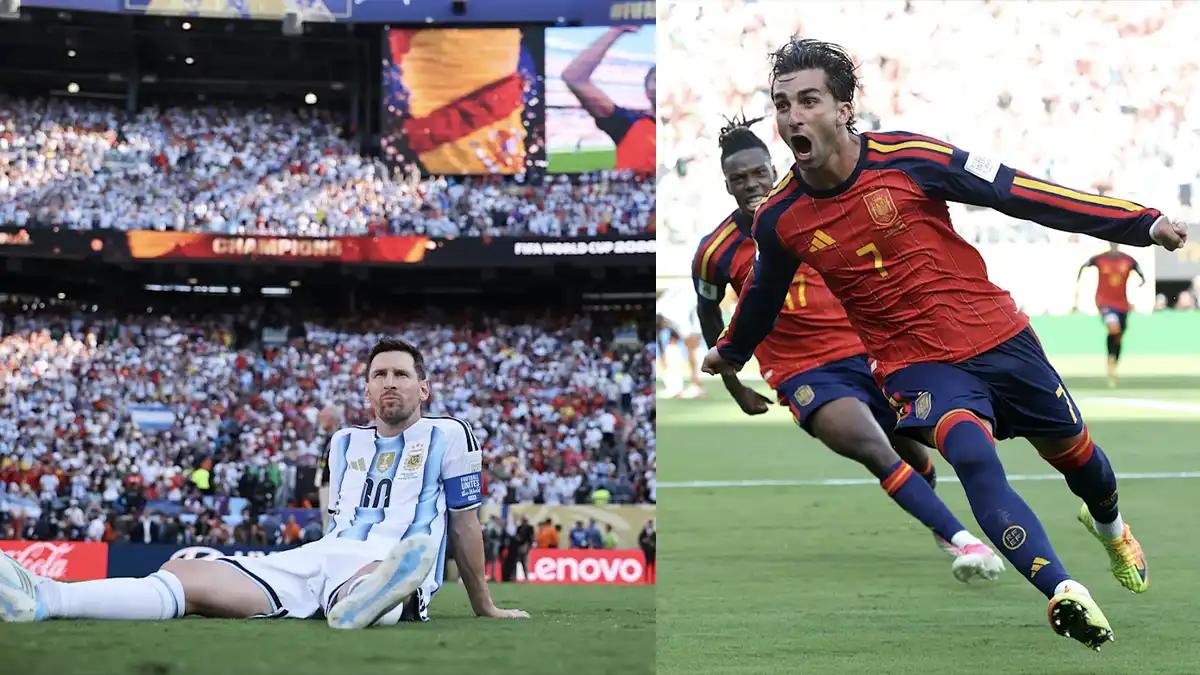
Image source: Tullio Puglia – FIFA via Getty Images | Hector Vivas – FIFA via Getty Images
For nearly 106 minutes, Spain controlled the World Cup final, squeezed the life out of Argentina and left Lionel Messi searching for answers. Then Ferran Torres delivered the moment La Roja had been waiting for.
Torres scored early in the second half of extra time as Spain defeated Argentina 1-0 at MetLife Stadium, ending a tense final and securing the country’s first World Cup title since 2010.
Spain dominated possession, territory and chances throughout the match. Argentina, meanwhile, spent most of the afternoon trying to survive. The defending champions managed only two shots — neither on target — after scoring 19 goals in their previous seven matches.
At one point, Argentina looked less like a team chasing history and more like a team desperately searching for the remote control.
Table of Contents
Ferran Torres Delivers Spain’s Golden Moment
The decisive goal arrived in the 106th minute.
Pedro Porro floated a dangerous ball toward the back post, where Nico Williams beat Nahuel Molina in the air. Argentina goalkeeper Emi Martínez had already moved toward the cross, leaving him badly positioned.
Williams headed the ball back across goal, and Torres reacted instantly. From close range, the Spain forward fired an 8-yard shot into the net to finally break the deadlock.
“I just saw the ball coming to me and I just shot with the power of all the Spanish people,” Torres said after the match.
It was the kind of finish Spain had been searching for all afternoon. The European champions had controlled the game, but Argentina’s defense and Martínez kept the final alive far longer than Spain would have preferred.
Argentina Barely Threatened Spain
Argentina entered the final hoping to become the first team since Brazil in 1962 to win back-to-back World Cups.
Instead, the defending champions struggled to create anything offensively.
Argentina finished the match with just two shots and no shots on target. The team also managed only eight touches inside Spain’s penalty area and held 35% possession after 90 minutes.
Spain, by contrast, produced 20 shots, 12 of which were on target, and recorded 31 touches in the Argentine box.
Martínez was forced into a record-setting performance for a World Cup final. He made eight saves before stoppage time and finished the match with 11.
Without him, the game might have been over long before extra time.
Messi Struggles as Spain Shut Down Argentina
The result was particularly painful for Messi, whose final World Cup appearance ended with Argentina unable to generate the possession needed to get him involved.
The 39-year-old forward had been outstanding throughout the tournament, but Spain’s pressure and control kept him largely quiet. Argentina struggled to move the ball forward, leaving Messi with few opportunities to influence the game.
Spain’s relentless movement made life difficult for Argentina from the opening whistle. Lamine Yamal repeatedly found dangerous positions, while Spain’s passing and pressing forced Argentina deeper and deeper.
The match became increasingly physical as the minutes passed. Argentina also lost Lisandro Martínez to injury before halftime and later went down to 10 men after Enzo Martínez was sent off following a late challenge on Pau Cubarsí.
That left Argentina facing extra time with one fewer player. Not exactly the ideal recipe for a comeback.
Spain Survive Late Drama Before Winning the Trophy
Despite Spain’s dominance, Argentina continued to hang around.
Martínez produced another spectacular save in the 93rd minute, diving to his right to deny Williams’ close-range header. Williams later appeared to score, but the goal was ruled out after Mikel Merino was penalized for a foul.
Spain also had its own missed opportunities. Merino sent a close-range header wide, while Yamal saw a dangerous free kick saved by Martínez.
As the game moved deeper into extra time, a penalty shootout began to feel inevitable.
Then Torres changed everything.
His goal finally broke Argentina’s resistance and gave Spain its first World Cup title since Andrés Iniesta’s famous extra-time winner against the Netherlands in 2010.
Spain Continue Remarkable Unbeaten Run
The victory extended Spain’s unbeaten streak to 38 matches, a run stretching more than two years.
For Argentina, the defeat marked its fourth loss in seven World Cup finals. The team had entered the tournament with confidence, experience and eight starters from its 2022 championship-winning squad.
But the final belonged entirely to Spain.
The atmosphere inside MetLife Stadium was electric despite the stadium’s otherwise plain NFL-style setting. Spanish red and yellow filled the stands, while Argentina’s famous sky-blue and white supporters created a wall of noise throughout the match.
Argentina’s fans had followed the team everywhere during the tournament, even taking over New York’s Times Square before the final. But on Sunday, Spain had the last word.
Spain’s 1-0 extra-time victory over Argentina was not the most spectacular World Cup final ever played, but it was a masterclass in control, pressure and patience.
Argentina could not find its rhythm, Messi was largely isolated and Martínez could only keep Spain away for so long. Eventually, Torres found the breakthrough and gave Spain another place in football history.
For Argentina, the dream of back-to-back World Cup titles ended in frustration. For Spain, a new golden chapter has officially begun.
FAQ:
Who won the World Cup final between Spain and Argentina?
Spain defeated Argentina 1-0 after extra time to win the World Cup.
Who scored the winning goal for Spain?
Ferran Torres scored the decisive goal in the 106th minute of extra time.
How did Ferran Torres score against Argentina?
Nico Williams headed the ball back across the box after a cross from Pedro Porro. Torres then fired an 8-yard shot past Argentina goalkeeper Emi Martínez.
How did Lionel Messi perform in the World Cup final?
Messi struggled to make a major impact as Spain dominated possession and limited Argentina’s attacking opportunities.
How many shots did Argentina have in the final?
Argentina managed just two shots, with neither attempt finding the target.
How many saves did Emi Martínez make?
Martínez made 11 saves during the match, keeping Argentina alive for much of the game.
Did Argentina play the entire match with 11 players?
No. Argentina was reduced to 10 players after Enzo Martínez received a red card following a late challenge on Pau Cubarsí.
When was Spain’s last World Cup title before this victory?
Spain’s previous World Cup title came in 2010, when Andrés Iniesta scored the extra-time winner against the Netherlands.
Did Spain remain unbeaten after defeating Argentina?
Yes. The victory extended Spain’s unbeaten run to 38 matches.
Was this Lionel Messi’s final World Cup appearance?
The match was described as the end of Messi’s World Cup career, making Spain’s victory an especially emotional conclusion for Argentina and its legendary forward.
Why did Argentina struggle against Spain?
Spain’s pressing, possession and movement prevented Argentina from building attacks consistently. The defending champions struggled to get the ball into dangerous areas and were unable to create regular scoring chances.
What does Spain’s victory mean for the team?
The win gives Spain its first World Cup title since 2010 and confirms its status as one of international football’s strongest teams after an impressive unbeaten run.
Also Read: Is Cam Schlittler’s Championship Mindset Exactly What the Yankees Need?
👉 If you like our content, please click here and add us as your preferred source. It helps us a lot, and we are committed to delivering you the very latest sports news.

